The new F tuba will be at
TMEA in San Antonio February 9-11
along with the innie/outie Euphonium and the rest of the Gemeinhardt brass.
Yes we make Horns and Trombones too!
Then Columbus, Ohio - February 16-18.

Saturday, February 4, 2012


Monday, January 30, 2012
Capitol Tuba Conference 2012

Capitol Tuba Conference at Ft Meyer. There were great performances that I didn’t get to see because I was tending the exhibit.
My sincere thanks to everyone who tried out my new tubas.
And thanks for the kind words. By many accounts the J-445 F tuba was the best F tuba there (and the best of the best were there).
And thanks for the input on the Euphonium. I will be incorporating a few more features in upcoming production.
I’ve posted pictures in the links to the right.
On the way home I stopped in Buffalo where Don Harry and Mark Jones took delivery of their J-445sp F tubas. Their comments: “This is even better than I remembered.” In choosing they flipped a coin. Both horns played the same as the sample they tried a month ago. Don took the proto-type CC to Eastman. Mark is going to use it in the Buffalo Philharmoninc but it will be back with me at the Ohio Music Educator Convention in February. Buffalo has scheduled 2 TWO tuba pieces in the same month! (Strauss and Harris.)

Thursday, December 1, 2011
The F and EEb tubas are now in production. .730"/.750" 18" bell. Designed in Elkhart, built in China.
If Pop Johnson had built an F, this is what it would be like. (I wish I still had chops.)
The compact (3/4) BBb tuba is also in production.
I have one of each in Elkhart and would be pleased to have anyone stop in and test drive. (Call first.)
See pictures on link: New Instruments for 2012 and F Tuba Don Harry at Kleinhans Hall . Mark Jones posted his comments on Tubenet "AMAZING new piston F and Eb tubas!!!"
I will be taking them to Florida MEA, Capitol Tuba Conference (Army), Texas MEA, Ohio MEA, NAMMM (California) and some stops along the way.
The new compensating Euphoniums with the dual action trigger are on the way. I'll post pictures soon.
Donald R. Harry (via facebook)
The new Gemeinhardt tubas were brought to Buffalo, I had played the cc awhile back and loved it. I already own the Bb and will own the f. The intonation, response and above all depth of sound is excellent. The Eb is rock solid. Congratulations to Dick Barth.
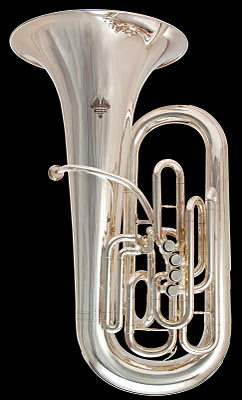
If Pop Johnson had built an F, this is what it would be like. (I wish I still had chops.)
The compact (3/4) BBb tuba is also in production.
I have one of each in Elkhart and would be pleased to have anyone stop in and test drive. (Call first.)
See pictures on link: New Instruments for 2012 and F Tuba Don Harry at Kleinhans Hall . Mark Jones posted his comments on Tubenet "AMAZING new piston F and Eb tubas!!!"
I will be taking them to Florida MEA, Capitol Tuba Conference (Army), Texas MEA, Ohio MEA, NAMMM (California) and some stops along the way.
The new compensating Euphoniums with the dual action trigger are on the way. I'll post pictures soon.
Donald R. Harry (via facebook)
The new Gemeinhardt tubas were brought to Buffalo, I had played the cc awhile back and loved it. I already own the Bb and will own the f. The intonation, response and above all depth of sound is excellent. The Eb is rock solid. Congratulations to Dick Barth.

Developing new product:
I’ve read with interest some comments on Tubenet and other places about the new Gemeinhardt tubas.
I believe the instruments will speak for themselves if played. You will ultimately vote with your checkbook.
But here is some history and some of the thought process:
1. The ‘Dependent’ Fifth valve. This is already controversial. I’m flattered.
Why the Dependent Fifth Rotor:
(I printed this as an additional page on the tuba fingering chart. Here it is with a few extra comments.)
Some of the greatest players in tuba history played four valve tubas. There is an undeniable more open feel to the tuba without the addition of a fifth valve in the open horn. On the other hand there are some distinct advantages to having a fifth valve in the low register. The dependent fifth valve joins the advantages of both.
The argument against the dependent fifth valve is the loss of an alternate fingering for the half step or whole step above the open second partial. There are other ways to deal with that one note. In fact many great tuba players have done so with four valve tubas. Some have opted for the automatic compensating system which requires very long valves and does not provide that alternate fingering.
If the player agrees that the overall quality of the instrument is preferable without the fifth valve in the open bugle, the question is simply whether an alternate fingering for one note (two with compromise) outweighs the advantage of feel and sound on 47 other notes.
Putting the valve in the large side of the main tuning slide as on Jake’s York means an extremely large rotor, significantly larger than the .812” rotor on the York. The F tuba would require a whopping .866” rotor. Big, sluggish and a significant interruption to the open horn. Putting it in the small side of the main tuning slide means taking 2” out of the tuning slide and still putting an interruption in the open bugle. Putting it ahead of the main cluster, in the lead pipe, is the most interruptive of all and requires the smallest tubing of any choice. Putting it in the fourth tubing allows it to be the larger .750” bore for a great low register and keeps it out of the way of the open bugle when not in use. If the one alternate fingering is more important, there is a plethora of instruments already on the market. It is my goal to offer an alternative to what is on the market. I hope it is better but the choice is yours.
2. Building instruments in China:
Growing up in Cleveland and discovering CC tuba in the early 60’s, I contacted the local band instrument manufacturer to see if I could purchase one. They told me they had made eleven for Bill Bell and his studio at I.U. but were so far behind on BBb tubas and Sousaphones they had no interest in making something special. Fast forward to the early 80’s, I am teaching Tuba at the University of Akron and am good friends with the design engineer at the same factory. We played in a quintet together. I ask him to build a CC tuba, explaining the benefits to the reputation of the brand. He finds enough parts remaining from the Bell Model to make a sample but the company management is not interested in the small market. Fast forward to the early 90’s. I am now working for that company as a District Manager. They finally acquiesce and make a CC tuba. As a salesman I am kept out of the developmental loop. The tuba goes into production and has moderate success and is discontinued in 2009 because ‘sales do not justify’. An F tuba makes it no farther than 2 proto-types. Such is the American desire to build CC and F tubas.
I have experience with factories in America, India, Brazil and China. I find the Chinese to be the most cooperative of all. They are capable of excellent quality as we have demonstrated with Gemeinhardt flutes. I am working to bring the same level to the brass and in the process hope to provide brass instruments of incredible value to musicians everywhere.
3. “Designed in Elkhart, built in China.” is not a slogan, it’s simply an honest statement of origin. I am not simply re-branding instruments made overseas. I am working to create the best instruments I can with designs made in Elkhart. I have sought, and will continue to seek, opinions from players. I am not building instruments for my own use, but instruments for musicians. I do not make changes based on a single player’s opinion. I try to take all input and filter it through my own view of the entire market based on 30 years on the manufacturing side of the business along with my previous professional career.
My proto-types are indeed built at the Gemeinhardt factory by a highly skilled craftsman retired from a local trumpet factory and myself. The designs are mine. As an example, the patent for the Dual-Use trombone is mine. The same craftsman inspects the brass instruments in our Elkhart factory and services them as needed. I have traveled several times to China to work with the factories and inspect instruments. We are working together to make our instruments ¬¬¬¬¬¬the best quality possible and the best value you can find.
Richard Barth December 2011
Wednesday, November 2, 2011
Wisconsin Music Educators Convention
Wisconsin Music Educators Convention October 2011 in Madison.
Pictures on links>
Good comments on new models.
Next stop US Brass Band Open St Charles IL Nov 5, 2011 then
Midwest Band and Orchestra Convention December 15-17.
I will have the F tuba, EEb, CC and new Euphonium along with horns and trombones.
Pictures on links>
Good comments on new models.
Next stop US Brass Band Open St Charles IL Nov 5, 2011 then
Midwest Band and Orchestra Convention December 15-17.
I will have the F tuba, EEb, CC and new Euphonium along with horns and trombones.

Saturday, February 26, 2011
Kill the Wabbit
I am just back from the Capitol Tuba Conference and the Texas Music Educators Convention. Some thoughts on testing instruments.
“Kill The Wabbit” is a good test of a tuba.
http://www.youtube.com/watch?v=Yxiv3CBMS4M
I hear it frequently, played well and sometimes not.
May I suggest?
First know the excerpt. Know the fingerings on the tuba at hand. Know the rhythm.
Second don’t test. Or as Mr. Jacobs said, “Make a statement. Don’t ask a question.” Mr. Jacobs said that even when you are warming up on stage before a concert, the conductor can often hear you. Don’t ask a question. Make a statement. Jake was ‘warming up’ before a master class he was giving. He played a few technical things and an operatic aria. Then he said, “You might wonder what I’m doing here. I’m showing off. There is always someone listening. You don’t need to warm up if you are playing five hours every day. You may need a maintenance routine but you don’t need to warm up. When you go on stage to test the acoustics, show off.”
So first, know the excerpt and then make a statement. Better to play something simple that you play well than to attempt something you don’t know.
Now a few suggestions about how to ‘kill the wabbit’. I took a few lessons with Ed Anderson, the bass trombonist in the Cleveland Orchestra at the time. I have the greatest respect for Ron Bishop as a person and a musician. I was fortunate to have had a few lessons with him. But I thought a few lesson with the person who sits next to the tubist would also be valuable. In fact, who is more likely to be behind the audition screen than a trombonist? Ed asked me to play the sixteenth notes louder than the dotted eighths. He then explained that George Szell asked for louder and louder sixteenths when they recorded the Ride of the Valkyries. Ed said it felt strange until he heard the recording and realized Szell’s wisdom. Szell said “Little notes are like little children. They demand more attention.”
So, how do you make the sixteenths louder than the dotted eights? Do NOT play the dotted eighths as loud as you can. It’s just that simple. I’ve done a little singing. Doo-Wop etc. I was once asked to sing the bass part in the country song Elvira. Most days I have a low C. Like every other bass I know, low C is not as loud as second space C. It is very tempting when the giddy-up part comes to belt it out. Big mistake. Sing it softer. That way you can sing a solid low C.
Here’s Barth’s Axiom #1. ‘Don’t play any loud passage louder than your weakest note.’ There is, of course, a corollary. ‘Don’t play any soft passage any softer than you are able to make every note speak.’
Axiom #2 is similar: ‘Crescendo means Start Softer’. Worth repeating: ‘Crescendo means Start Softer.’ Even if you are playing a loud passage, the best way to make an effective crescendo is to drop the volume down a little when you see ‘crescendo’.
“Kill The Wabbit” is a good test of a tuba.
http://www.youtube.com/watch?v=Yxiv3CBMS4M
I hear it frequently, played well and sometimes not.
May I suggest?
First know the excerpt. Know the fingerings on the tuba at hand. Know the rhythm.
Second don’t test. Or as Mr. Jacobs said, “Make a statement. Don’t ask a question.” Mr. Jacobs said that even when you are warming up on stage before a concert, the conductor can often hear you. Don’t ask a question. Make a statement. Jake was ‘warming up’ before a master class he was giving. He played a few technical things and an operatic aria. Then he said, “You might wonder what I’m doing here. I’m showing off.
So first, know the excerpt and then make a statement. Better to play something simple that you play well than to attempt something you don’t know.
Now a few suggestions about how to ‘kill the wabbit’. I took a few lessons with Ed Anderson, the bass trombonist in the Cleveland Orchestra at the time. I have the greatest respect for Ron Bishop as a person and a musician. I was fortunate to have had a few lessons with him. But I thought a few lesson with the person who sits next to the tubist would also be valuable. In fact, who is more likely to be behind the audition screen than a trombonist? Ed asked me to play the sixteenth notes louder than the dotted eighths. He then explained that George Szell asked for louder and louder sixteenths when they recorded the Ride of the Valkyries. Ed said it felt strange until he heard the recording and realized Szell’s wisdom. Szell said “Little notes are like little children. They demand more attention.”
So, how do you make the sixteenths louder than the dotted eights? Do NOT play the dotted eighths as loud as you can. It’s just that simple. I’ve done a little singing. Doo-Wop etc. I was once asked to sing the bass part in the country song Elvira. Most days I have a low C. Like every other bass I know, low C is not as loud as second space C. It is very tempting when the giddy-up part comes to belt it out. Big mistake. Sing it softer. That way you can sing a solid low C.
Here’s Barth’s Axiom #1. ‘Don’t play any loud passage louder than your weakest note.’ There is, of course, a corollary. ‘Don’t play any soft passage any softer than you are able to make every note speak.’
Axiom #2 is similar: ‘Crescendo means Start Softer’. Worth repeating: ‘Crescendo means Start Softer.’ Even if you are playing a loud passage, the best way to make an effective crescendo is to drop the volume down a little when you see ‘crescendo’.
Production Pipe Angle

Yes the J-870 is in production. The mouthpipe angle is just like the sample I had in DC and SanAntonio. Milano Music has 2 and three more on order.
Subscribe to:
Posts (Atom)